Do we love across time? Or in spite of it? A developer has slated an ancient Abenaki Indian burial ground for a strip mall, and now strange happenings have tiny Comtosook, Vermont, talking of supernatural forces at work. Second Glance delves into a very ugly and little known chapter of American history: Vermont's eugenics project of the 1920s and 30s. …more
Exploring the dark history of America's eugenics movement, Picoult sneaks in a ghost story… a gratifying blend of gothic melodrama and social critique… A balance of suspense and science makes for a memorable ghost tale.
Jodi joins BBC radio host Simon Mayo to talk about Handle with Care
Second Glance expertly entwines a powerful drama of the heart’s redemption and the disturbing real-life history of the Vermont eugenics project of the 1930’s in a love story that crosses time and worlds.
The publisher: Atria Books, 2003; paperback by Washington Square Press, 2004. (Book 10)
Ross Wakeman is a ghost hunter who's never seen a ghost-all he's searching for is something to end the pain of losing his fiance Aimee in a car accident. He tried suicide-any number of times. Now Ross lives only for a way to connect with Aimee from beyond. Searching the site for signs of the paranormal, Ross meets the mysterious Lia, who sparks him to life for the first time in years. But the discoveries that await Ross are beyond anything he could dream of in this world-or the next. Expertly entwining a powerful drama of the heart's redemption and the disturbing real-life history of the VT eugenics project of the 1930s, Second Glance asks if truth is always something that can be measured… and if what can be measured is indeed always true.
I have to admit, I learned about it by accident. I was intent on writing a ghost story, and my search for a fictional ghost led me to the Abenaki Indians in Vermont, who often protest development because they allege the land is an ancient burial ground. I started doing a little research on the Abenaki, and found an article from the Boston Globe that discussed the Vermont eugenics project and its effect on the Abenaki, as chronicled in the thesis of a woman named Nancy Gallagher. The more I read, the more stunned I was - in the 1920s and 30s in Burlington VT, a bunch of very progressive thinkers - doctors, lawyers, university professors - decided to preserve the state's rural charm by getting rid of the people they didn't think fit the bill… namely, people who weren't white, Protestant Yankees. They began by organizing a survey that mapped out extended 'degenerate' families they felt were a drain on the economy, due to repeat stints in poorhouses and mental institutions and prisons. Often, these were Abenaki Indians, French Canadians, and indigent folks. Eventually, a law was passed that supported voluntary sterilization of these individuals. Unfortunately, 'voluntary' was not always a matter of free will - in many cases, only two doctors had to sign off on a case to make it happen. Hundreds of Abenaki Indians and others were sterilized before funding dried up in the late 1930s - thanks to the Nazis, who credited American eugenics programs with laying the groundwork for their own plans for racial hygiene.
Well, reading this now, you probably feel a bit like I did - shocked that this happened only 70 years ago, shocked that it happened in America, and shocked that I didn't know about it before. But what really resonated in me was that it continues to happen: today's debate over mapping the human genome and cloning and gene replacement therapy addresses many of the same issues that were raised by scientists who supported eugenics years ago. I wanted to explore the idea that all sorts of things come back to haunt you - including history. And I wanted to show that the scientists of the 1920s and 30s were not evil Dr. Frankensteins, but rather progressive thinkers who truly believed they were doing the right thing at that moment. Yet at the same time I wanted to remind people that just because science is measurable and verifiable doesn't mean it's something we should automatically believe in.
When I was doing my research, I found many prickly people. From historians who worried about reopening this can of worms, to Abenaki who wanted to know why, as a white, I thought I had the right to tell this story - I wasn't always sure that I was doing the right thing. In the end, I have always believed that the job of a writer is to make people question their beliefs… and while I am not judging either the eugenicists or the Abenaki in this book, I think people deserve to know what happened… even if it's been coated in a fictional tale. I did not tell this story for the shock value. I told it because I had to.
I wouldn't say that Vermont was 'hiding' these projects. I think they just sort of fell by the wayside. Once funding dried up, there was no one championing eugenics before the state legislature. And after World War II, I imagine there was a certain discomfort in discussing what had gone on. At any rate, the genealogy charts of degenerate families and the paperwork were forgotten for years, until they were found by a man named Kevin Dann, a Vermont historian, who began to bring them to light. And although it's easy to dismiss this as a single blight in U.S. history, the sad truth is that more than half the states in America had, at some point, a sterilization law on the books.
After Hitler came into power and the worst-case-scenario of eugenics moved into the spotlight, American eugenicists no longer commanded the same sort of attention they had before. Money disappeared, and projects died out. The prominent men and women who were involved went back to teaching, or grew famous in offshoot capacities (i.e. Margaret Sanger and her work with birth control). Eventually in the 1960s and 70s the ACLU was successful in repealing many of the sterilization laws still on state books, or changing the language so that the rights of the individual were protected more fully. Of late, several states have formally apologized to the victims of the eugenics legislature.
In Vermont, no one ever apologized. And because northern New England is one of those places where people don't tend to move around very much, the descendents of both the leaders of the eugenics project and the victims of the eugenics project still live in close proximity. Some families of the scientists feel shame as well as anger, since their relatives are often portrayed as evil megalomaniacs, when that was not the case. Some families of the Abenaki are resigned and bitter, and prefer not to open up a wound that still smarts. For these reasons, and many others, it has been easier for both groups to sweep what happened under the proverbial carpet, rather than to bring it out into the open.
Oh, yeah, the Abenaki exist! Thousands of years ago, they covered the area from northwest Vermont to the southeast, as well as parts of western Massachusetts, bits of New Hampshire, and some of Quebec. Their name, Abenaki, means 'people of the dawn.' At one point they numbered 40,000; now there are about 2500 left.
The interesting thing about the Abenaki, historically, is that they didn't have a central authority. In war times, they'd leave their villages in small groups, and reband somewhere else to plan an attack. They got very proficient at going underground, as it were, in order to save themselves. And this is exactly what they did years later when they became targets of the eugenics project. Unlike white folks, some of them had migratory lifestyles and didn't even live in houses. Some of them chose not to be married in a Christian church. Their kids didn't always go to public school, and didn't dress 'normally.' They seemed to get thrown into jail a lot (a cyclical thing, since the reason they were arrested was because they weren't behaving the way a 'white man' should.) It was their difference as a cultural group - their 'otherness' - that led the eugenicists to believe they didn't fit the picture-postcard image of Vermont although, of course, the Abenaki had been there first.
When the eugenicists started rounding up some of these alleged degenerates, the Abenaki did what they had always done well - they split up and resurfaced in white clothes, doing white jobs, marrying whites so that they'd have white surnames… and being 'Indian' behind closed doors. They did what they had to to keep their entire cultural tradition from being wiped out by the eugenics project. However, this behavior cost them dearly. Today, they are not federally recognized as a tribe - which would net them funds to do things like buy back land they feel is a burial ground - because they do not have a continuous, unbroken line of native history. Their survival tactics during the eugenics project of the 20s and 30s, meant to keep their traditions alive, ironically has turned them into ghosts whose collective voice cannot be heard. Of all the things I learned about the eugenics project, this seemed to me the saddest.
I'm not Abenaki, and it's always a little daunting to write about a people when you're not a member of the group. I was at the University of Vermont doing an event while I was working on Second Glance, and an audience member asked me about my book-in-progress. When I finished talking about it, a woman stood up. She was Abenaki, and she was crying. 'Thank you,' she said, 'for telling this story.' I know not every Abenaki will feel that way about Second Glance, but I would hope that they find I have addressed this very painful chapter of their history with respect.
Like I said, the ghost story element came first. And to tell you the truth, I thought I might be able to fudge some of the ghost stuff, instead of being the research guru I tend to be. But then I realized I would indeed hear from every reader in the country who has seen a ghost to tell me I got it all wrong, and I decided I'd try to find someone who could, with authority, tell me about ghost hunting. I looked on the Internet, and found the Atlantic Paranormal Society, and left an email for each of the founders. I figured it might take a while to find someone who believed in ghosts, but no, I had responses from all of the guys within hours. Jason Hawes and Grant Wilson were more than happy to speak to me about paranormal investigation. They suggested that I come down to Rhode Island, where they are based, so that they could take me out on a ghost hunt.
This was particularly interesting. I mean, here I was telling my children at night there's no such thing as ghosts… but dressing in black and heading out to an abandoned New England mental institution in the dead of a January night with a bunch of paranormal investigators. The building was boarded up - it had been the pool room, and I could see the empty inground pool full of leaves and debris. In the background, too, I saw what looked like fireflies - something the paranormal investigators said were globules, or energy changing form. Afterward, we walked across a field where one of the buildings had burned to the ground, with patients inside. I was walking with a sensitive (someone who can 'feel' ghosts). It was very cold out, and very clear, and our breath was visible in front of us. Suddenly all the hair stood up on the back of my neck. Before I could even mention this to my walking buddy, he lifted a digital camera and held it up between us backward, over our shoulders.
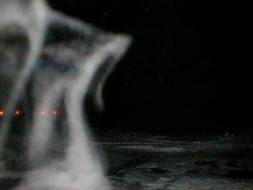
Now, it's important to remember a) our breath was in front of us and b) there was no one and nothing behind us. This is just what showed up in the camera. A ghost hunter will tell you that sometimes, ghosts can affect film or digital photography because of heat or magnetic energy.
From here we went on a real, live, ghost hunting call. A couple just over the border in Massachusetts had - they thought - a ghost. They wanted TAPS to come confirm it. What truly impressed me about this group was that they made fun of themselves plenty - Ghostbusters jokes abounded - and they didn't charge their 'clients.' No one, they believed, should be penalized for having a ghost; in my mind, it meant they weren't out to find something just for the money.
The house was small, and the bumps and thumps the inhabitants had heard were in the attic, a small third-floor room with a little door and a padlock. The TAPS guys gave me the only key, and then set a video camera up in the middle of the attic. Often this way they will catch something - more globules, noise, voices. The attic was swept absolutely clean, there was nothing paranormal to be seen. I was the last one out of the room, and I padlocked it behind me, then slipped the key into my pocket. As the others went downstairs to talk, I checked in the bedrooms of the couples' two children - both sleeping comfortably in cribs, in rooms that were completely clean and orderly. Downstairs, the couple described hearing calliope music at 2 AM, only to find a child's toy piano on the attic stairs. Coming home and finding all the faucets running or the cereal boxes knocked out of the cabinets, contents spilled. Rooms that got, suddenly, twenty degrees colder. After listening for a while, I said I was going back upstairs. Again, I ducked into the room of the first child. Now, lining the carpet on the edge of the crib, there were six pennies that had not been there before, all dated between 1968 and 1972. I picked them up and put them in my pocket and went into the next child's room to find the same thing - six pennies, all dated between those years. Finally I went to the attic, took out the key, unlocked the padlock, and flipped on the lights to find a handful of pennies beneath the video camera, all dated between 1968 and 1972. I can't tell you that there was a ghost there, but I can tell you that if you look in your wallet, you'll be hard pressed to find a single penny with that date on it, much less thirty.
I believe there is a lot in this world we don't understand. And that seeing ghosts is often an all or nothing thing - people don't believe until they see one, and then - bam! - they're convinced. Did I see Casper? Nope. But I did see things I could not reasonably explain, and that leads me to believe that ghosts are certainly possible. One of the most enjoyable parts of writing Second Glance was exploring the nature of belief. We're predisposed to think that if there isn't scientific proof, something doesn't exist… but as I pointed out earlier, science isn't always right… and proof can't always be measured in a beaker or a lab test. People say you can't believe in a ghost, because you can't see it or touch it or capture it. By that criteria, though, those people have to say that love doesn't exist, either… and yet most of us have experienced that in some form or another.
When you write something with any sort of historical relevance there is such an awesome responsibility attached to it, a driving need to get it one hundred percent accurate. But in this case, especially, the theme of history repeating itself made diving into the past absolutely necessary. I had a very hard time deciding whether or not to use the names of some of the real players in the eugenics project - like Harry Perkins, for example. He exists in the book, but as a character who is talked about and never met. The main cast is all imaginary, so that their issues and tangles and choices come from my imagination.
The fluidity between the past and the present was really based in the characters of Lia, and Meredith. Lia's link is obvious, but Meredith's ties are more intellectual. As a preimplantation genetic diagnostician, she is the modern day incarnation of yesterday's eugenicist: a woman who uses science to do good, by employing techniques that - in the wrong hands - could be devastating. While I was working on Second Glance I had a lot of arguments with a friend of mine, a medical researcher who does not support stem cell research. I do. The problem isn't the science, in my opinion; it's in who decides what's 'normal' or 'optimal' or 'valuable.' It was not the eugenicist's desire to make the world a better place that was faulty - it was the way they chose to define 'better.'
Of all my books, this was the most technically difficult to write. It felt like I was performing brain surgery - setting up all these open plugs in the first part so that I could join them to their resolutions in the last part. There are so many twists and turns in Second Glance, and that was tough to pull off, because when you write about history there's a sense of inherent closure and expectation. You read the book, and you think you know what's coming… but in fact, you don't.
“Jodi Picoult’s clear ear for dialogue quickly establishes a diverse cast in this superb love story... Like Louise Erdrich, she suffuses complex, exciting, big plots with the subtle pace of Native American affairs, producing unsentimental, passionate sagas.”
— Financial Times
A featured selection of the Literary Guild
Best Mainstream Book of the Year Award, Romance Writers of America
“Jodi Picoult’s clear ear for dialogue quickly establishes a diverse cast in this superb love story... Like Louise Erdrich, she suffuses complex, exciting, big plots with the subtle pace of Native American affairs, producing unsentimental, passionate sagas.”
— Financial Times
“Best-selling author Picoult mixes shocking fact and compelling fiction to produce a mesmerizing tale of love and second chances.”
— Booklist
“Ghosts and ghost hunters collide in this compelling tale of the paranormal set in Vermont's green mountains… Picoult brings the past alive and peoples it with a cast of extraordinarily well-realized characters… Second Glance is an intricate and suspenseful ghost story that enchants and illuminates all the way to its powerful conclusion.”
— Amazon.com editorial review
“Picoult ingeniously ties the ghost story to a true one about eugenics. . . . The history lesson makes for chilling, even shocking, reading, and Picoult comes up with many unforgettable characters. . . . Bottom line: Great ghost story.”
— People (Critic's Choice)
“[An] elaborate, engrossing plot. . . . Suspense and the supernatural are artfully interwoven. . . . Picoult's ability to bring [her characters] all vividly to life is remarkable.”
— Publishers Weekly (starred review)
“Memorable visual images and evocative language. . . .[A] multifaceted work.”
— Library Journal
“Thought-provoking and eminently discussable SECOND GLANCE is a mix of ghost, mystery, and love stories, but it is also a sharp social commentary.”
— The Denver Post
“A fun read. The flashbacks to 1932 Vermont are fresh and vivid. The ghosts are entertaining, and like all good mysteries, the key to solving the crime comes as an unexpected surprise.”
— Milwaukee Journal-Sentinel
“A gratifying blend of gothic melodrama and social critique. … A balance of suspense and science makes for a memorable ghost tale.”
— Kirkus Reviews
“An intelligent, complex, challenging, and utterly compelling novel.”
— Sydney Morning Herald (Australia)
“Fascinating. . . . Picoult fans will enjoy this; those new to her fiction will have discovered a treasure.”
— Winston-Salem Journal (NC)
Ross Wakeman succeeded the first time he killed himself, but not the second or the third.
He fell asleep at the wheel and drove his car off a bridge into a lake– that was the second time– and was found on the shore by rescuers. When his half– sunken Honda was recovered, the doors were all locked, and the tempered glass windows were shattered like spider webs, but still intact. No one could figure out how he’d gotten out of the car in the first place, much less survived a crash without even a scratch.
The third time, Ross was mugged in New York City. The thief took his wallet and beat him up, and then shot him in the back and left him for dead. The bullet — fired close enough to have shattered his scapula and punctured a lung — didn’t. Instead it miraculously stopped at the bone, a small nugget of lead that Ross now used as a keychain.
The first time was years ago, when Ross had found himself in the middle of an electrical storm. The lightning, a beautiful blue charge, had staggered out of the sky and gone straight for his heart. The doctors told him that he had been legally dead for seven minutes. They reasoned that the current could not have struck Ross directly, because 50,000 amperes of current in his chest cavity would have boiled the moisture in his cells and quite literally made him explode. Instead, the lightning had hit nearby and created an induced current in his own body, one still strong enough to disturb his cardiac rhythm. The doctors said he was one hell of a lucky man.
They were wrong.
Now, as Ross walked up the pitched wet roof of the O’Donnell’s Oswego home in the dark, he did not even bother with caution. The wind coming off Lake Ontario was cold even in August, and whipped his long hair into his eyes as he maneuvered around the gabled window. The rain bit at the back of his neck as he worked the clamps onto the flashing and positioned the waterproof video camera so that it was pointing into the attic.
His boots slipped, dislodging some of the old shingles. On the ground, beneath an umbrella, O’Donnell squinted up at him.”Be careful,”the man called out. Ross also heard the words he did not say: We’ve got enough ghosts.
But nothing would happen to him. He would not trip; he wouldn’t fall. It was why he volunteered for the riskiest tasks; why he put himself into danger again and again. It was why he’d tried bungee jumping and rock climbing and crack cocaine. He waved down to Mr. O’Donnell, indicating that he’d heard. But just as Ross knew that in eight hours, the sun would come up– just as he knew that he’d have to go through the motions for another day– he also knew he couldn’t die, in spite of the fact that it was what he wanted, more than anything.
The baby woke Spencer Pike, and he struggled to a sitting position. In spite of the nightlights kept in every room at the Shady Pines Nursing Home– nearly enough combined wattage, he imagined, to illuminate all of Burlington, Vermont– Spencer couldn’t see past the foot of his bed. He couldn’t see anything these days, thanks to the cataracts; although sometimes he’d get up to take a leak and in the mirror, as he passed by, he would catch a glimpse of someone watching him– someone whose brow was not spotted and yellow; someone whose skin was not sighing off his bones. But then the young man Spencer had once been would disappear, leaving him to stare at the crumbs that were left of his life.
His ears, though, were sharp. Unlike the other sorry old morons in this place, Spencer had never needed a hearing aid. Hell, he heard things that he didn’t even care to.
On cue, the baby cried again.
Spencer’s hand scrabbled over the covers to the call button beside his bed. A moment later, the night nurse came in.”Mr. Pike,”she said.”What’s the matter?”
“The baby’s crying.”
The nurse fussed behind him, turning pillows and raising the head of the bed.”There are no babies here, Mr. Pike, you know that. It was just a dream.”She patted the right angle that had once been his strong shoulder.”Now, you need to go back to sleep. You’ve got a busy day tomorrow. A meeting, remember?”
Why, Spencer wondered, did she talk to him as if he were a child? And why did he react like one– sinking back beneath her gentle hands, letting her pull the covers up to his chest? A memory swelled at the base of Spencer’s throat, something that he could not quite pull to the front of the fog but that brought tears to his eyes.”Do you need some Naproxen?”the nurse asked kindly.
Spencer shook his head. He had been a scientist, after all. And no laboratory had yet crafted the drug that could ease this ache.
In person, Curtis Warburton was smaller than he seemed to be on television, but he lacked none of the magnetism that had made Bogeyman Nights the highest– rated show in its time slot. His black hair was shot, skunk– like, with a white streak– one he’d possessed since a night nine years ago, when the ghost of his grandfather had appeared at the foot of his bed and led him into the field of paranormal investigation. His wife Maylene, an elf of a woman whose psychic abilities were well known to the Los Angeles police, perched beside him, taking notes as Curtis posed questions to the owners of the house.
“First was the kitchen,”murmured Eve O’Donnell, and her husband nodded. A retired couple, they’d bought this home on the lake as a summer retreat, and in their three months of tenancy had experienced supernatural phenomena at least twice a week.”About ten in the morning I went to the post office, locked up all the doors, and put on the alarm system. When I came home, the alarm was still on… but inside, the kitchen cabinets were open, and every cereal box was on the table, spilled on its side. I called Harlan, thinking he’d come home from work and left behind a mess.”
“I was in a meeting the whole time,”her husband interjected.”Never came home. No one did.”
“And there’s the calliope music we heard coming from the attic at two in the morning. The minute we went upstairs, it stopped. Open the door to find a child’s toy piano, missing its batteries, sitting in the middle of the floor.”
“We don’t own a toy piano,”Harlan added.”Much less a child.”
“And when we put in the batteries, it didn’t even play that kind of music.”Eve hesitated.”Mr. Warburton, I hope you understand that we’re not the kind of people who… who believe in this sort of thing. It’s just… it’s just that if it’s not this, then I’m losing my mind.”
“Mrs. O’Donnell, you’re not going crazy.”Curtis touched her hand with trademark sympathy.”By tomorrow morning we’ll have a better idea of what’s going on in your home.”He looked over his shoulder to make sure Ross was getting this on camera. Depending on what happened later, the O’Donnell’s might find themselves featured on Bogeyman Nights, and if so, this footage was critical. The Warburtons received over 300 emails a day from people who believed their houses were haunted. Eighty– five percent of the claims turned out to be hoaxes or mice in the rafters. The rest– well, Ross had been working with them long enough to know there were some things that simply could not be explained.
“Have you experienced any spectral visions?”Curtis asked.”Temperature changes?”
“Our bedroom will be hot as hell one minute, and then we’ll be shivering the next,”Harlan answered.
“Are there any spots in the house in particular where you feel uncomfortable?”
“The attic, definitely. The upstairs bathroom.”
Curtis’s eyes swept from the hand– knotted Oriental rug to the antique vase on the mantel of the fireplace.”I have to warn you that finding a ghost can be a costly proposition.”
As the Warburtons’ field researcher, Ross had been sent to libraries and newspaper archives to locate documents about the property– and hopefully the bonus information that a murder or a suicide might have occurred there. His inquiry had turned up nothing, but that never stopped Curtis. After all, a ghost could haunt a person as well as a place. History could hover, like a faint perfume or a memory stamped on the back of one’s eyelids.
“Whatever it takes,”Eve O’Donnell said.”This isn’t about money.”
“Of course not.”Curtis smiled and slapped his palms on his knees.”Well, then. We’ve got some work to do.”
That was Ross’s cue. During the investigation, he was responsible for setting up and monitoring the electromagnetic equipment, the digital video cameras, the infrared thermometer. He worked for minimum wage, in spite of the money that came in from the TV show and from cases like this one. Ross had begged the Warburtons for a job nine months ago after reading about them in the L.A. Times on Halloween. Unlike Curtis and Maylene, he had never seen a spirit– but he wanted to, badly. He was hoping that sensitivity to ghosts might be something you could catch from close contact, like chicken pox– and, like chicken pox, might be something that would mark you forever.
“I thought I’d check the attic,”Ross said.
He stood in the doorway for a moment, waiting for Eve O’Donnell to lead the way upstairs.”I feel foolish,”she confided, although Ross had not asked.”At my age, seeing Casper.”
Ross smiled.”A ghost can shake you up a little, and make you think you’re nuts, but it’s not going to hurt you.”
“Oh, I don’t think she’d hurt me.”
“She?”
Eve hesitated.”Harlan said I shouldn’t volunteer any information. That way if you see what we do, then we’d know.”She shivered, glanced up the narrow stairs.”My little sister died when I was seven. Sometimes I wonder… can a ghost find you, if she wants to?”
Ross looked away.”I don’t know,”he said, wishing he could have offered her more– a concrete answer, a personal experience. His eyes lit on the small door at the top of the stairs.”Is that it?”
She nodded, letting him pass in front of her to unlatch it. The video camera Ross had mounted outside watched them from the window, a cyclops. Eve hugged herself tightly.”Being here gives me the chills.”
Ross moved some boxes, so that no shadows would be caught on tape that could be explained away.”Curtis says that’s how you know where to find them. You go with what your senses are telling you.”A wink on the floor caught his eye; kneeling, he picked up a handful of pennies.”Six cents.”He smiled.”Ironic.”
“She does that sometimes.”Eve was edging toward the door, her arms wrapped around herself.”Leaves us change.”
“The ghost?”Ross asked, turning, but Eve had already fled down the stairs.
Taking a deep breath, he closed the door to the attic and shut the light, plunging the small room into blackness. He stepped off to the side where he would not be in range of the video camera, and activated it with a remote control. Then he fixed his attention on the darkness around him, letting it press in at his chest and the backs of his knees, as Curtis Warburton had taught him. Ross cracked open his senses until the lip of disbelief thinned, until the space around him bloomed. Maybe this is it, he thought. Maybe the coming of ghosts feels like a sob at the back of your throat.
Somewhere off to the left was the sound of a footfall, and the unmistakable chime of coins striking the floor. Switching on a flashlight, Ross swung the beam until it illuminated his boot, and the three new pennies beside it. “Aimee?”he whispered to the empty air.”Is that you?”
Comtosook, Vermont was a town marked by boundaries: the dip where it slipped into Lake Champlain, the cliffs that bordered the granite quarry where half the residents worked, the invisible demarcation where the rolling Vermont countryside became, with one more step, the city of Burlington. On the congregational church in the center of town hung a plaque from Vermont Life magazine, dated 1994, the year that Comtosook was lauded as the most picture– perfect hamlet in the state. And it was– there were days Eli Rochert looked at the leaves turning, rubies and amber and emeralds, and he simply had to stop for a moment and catch his breath.
But whatever Comtosook was to tourists, it was Eli’s home. It had been, forever. He imagined it always would be. Of course, as one of the two full– time police officers in the town, he understood that what the tourists saw was an illusion. Eli had learned long ago that you can stare right at something, and not see what lies beneath the surface.
He drove along Cemetery Road, his usual patrol haunt on nights such as this, when the moon was as beaded and yellow as a hawk’s eye. Although the windows were rolled down, there wasn’t much of a breeze; and Eli’s short black hair was damp at the nape of his neck. Even Watson, his bloodhound, was panting in the seat beside him.
Old headstones listed like tired foot soldiers. In the left corner of the cemetery, near the beech tree, was Comtosook’s oddest gravestone. WINNIE SPARKS, it read. BORN 1835. DIED 1901. DIED 1911. Legend had it that the irritable old woman’s funeral procession had been en route to the cemetery when the horses reared and her coffin fell out of the wagon. As it popped open, Winnie sat up and climbed out, spitting mad. Ten years later when she died– again– her long– suffering husband hammered 150 nails to seal the lid of the coffin, just as a precaution.
Whether it was true or not didn’t much matter to Eli. But the local teens seemed to think that Winnie’s inability to stay dead was good enough reason to bring six– packs and pot to the cemetery. Eli unfolded his long body from the truck.”You coming?”he said to the dog, which flopped down on the seat in response. Shaking his head, Eli slipped through the cemetery until he reached Winnie’s grave, where four kids too wasted to hear his footsteps were huddled around the blue– fingered flame of a Sterno burner.
“Boo,”Eli said flatly.
“It’s the cops!”
“Damn!”There was a scuffle of sneakers, the ping of bottles clinking together as the teens scrambled to get away. Eli could have had them at any moment, of course; he chose to let them off this time. He turned the beam of his flashlight onto the last of the retreating figures, then swung it down toward the mess. They left behind a faint cloud of sweet smoke and two perfectly good unopened bottles of Rolling Rock that Eli could make use of when he went off– duty.
Bending down, he pulled a dandelion from the base of Winnie’s headstone. As if the motion had dislodged it, a word rolled into his mind: chibaio… .ghosts. His grandmother’s language, which burned on Eli’s tongue like a peppermint.”No such thing,”he said aloud, and walked back to the car to see what else this night might hold in store.
Shelby Wakeman had awakened exhausted after a full day’s sleep. She’d been having that dream again, the one where Ethan was standing beside her in an airport, and then she turned around to find that he’d disappeared. Frantic, she’d run from terminal to terminal looking for him, until at last she flew out a door onto the Tarmac and found her nine– year– old standing in the path of an incoming jet.
It terrified her, no matter how often Shelby told herself that this would never happen– she’d never be in an airport with Ethan in the middle of the day, much less lose sight of him. But what frightened her most was that image of her son standing with his arms outstretched, his buttermilk face lifted up to the sun.
“Earth to Mom… hello?”
“Sorry.”Shelby smiled.”Just daydreaming.”
Ethan finished rinsing his plate and setting it into the dishwasher.”Do you think it’s still daydreaming if you do it at night?”Before she could answer, he grabbed his skateboard, as much an appendage as any of his limbs.”Meet you out there?”
She nodded, and watched Ethan explode into the front yard. No matter how many times she told him to be quiet– at 4 A.M., most people were asleep, not racing around on skateboards– Ethan usually forgot, and Shelby usually didn’t have the heart to remind him.
Ethan had XP, xeroderma pigmentosum, an incredibly rare inherited disease that left him extremely sensitive to the sun’s ultraviolet rays. In the world, there were only a thousand known cases of XP. If you had it, you had it from birth, and you had it forever.
Shelby had first noticed something was wrong when Ethan was six weeks old, but it took a year of testing before he was diagnosed with XP. Ultraviolet light, the doctors explained, causes damage to human DNA. Most people can automatically repair that damage… but XP patients can’t. Eventually the damage affects cell division, which leads to cancer. Ethan, they said, might live to reach his teens.
But Shelby figured if sunlight was going to kill her son, all she needed to do was to make it infinitely dark. She stayed in days. She read Ethan bedtime books by candlelight. She covered the windows of her house with towels and curtains that her husband would rip down every night when he came home from work.”No one,”he’d said,”is allergic to the goddamned sun.”
By the time they were divorced, Shelby had learned about light. She knew that there was more to fear than just the outdoors. Grocery stores and doctor’s offices had fluorescent fixtures, which were ultraviolet. Sunblock became as common as hand cream, applied inside the house as well as out. Ethan had twenty– two hats, and he donned them with the same casual routine that other children put on their underwear.
Tonight he was wearing one that said I’m With Stupid. The brim was curled tight as a snail, a shape Ethan cultivated by hooking the lip of the hat beneath the adjustable band in the back. When Shelby saw the caps being stored that way, she thought of swans tucking their heads beneath a wing; of the tiny bound feet of the Chinese.
She finished cleaning up the kitchen and then settled herself with a book on the edge of the driveway. Her long, dark hair was braided into submission, thick as a fist, and she was still hot– how on earth could Ethan race around like that? He ran his skateboard up a homemade wooden ramp and did an Ollie kickflip.”Mom! Mom? Did you see that? It was just like Tony Hawk.”
“I know it,”Shelby agreed.
“So don’t you think that it would be totally sweet if we – ”
“We are not going to build a half– pipe in the driveway, Ethan.”
“But – ”
“Jeez. Whatever.”And he was gone again in a rumble of wheels.
Inside, Shelby smiled. She loved the attitude that seemed to be creeping into Ethan’s personality, like a puppeteer throwing words into his mouth. She loved the way he turned on Late Night with Conan O’Brien when he thought she was somewhere else in the house, to try to catch all the innuendoes. It made him… well, so normal. If not for the fact that the moon was riding shotgun overhead, and that Ethan’s face was so pale the veins beneath his skin glowed like roads she knew by heart– if not for these small things, Shelby could almost believe her world was just like any other single mother’s.
Ethan executed a shifty pivot, and then a Casper big spin. There was a time, Shelby realized, when she couldn’t have distinguished a helipop from a G– turn. There was also a time Shelby would have looked at Ethan and herself and felt pity. But Shelby could hardly remember what her existence had been like before this illness was flung over them like a fishing net; and truth be told, any life she’d lived before Ethan could not have been much of a life at all.
He skidded to a stop in front of her.”I’m starving.”
“You just ate!”
Ethan blinked at her, as if that was any kind of excuse. Shelby sighed.”You can go in and have a snack if you want, but it’s looking pink already.”
Ethan turned toward the sunrise, a claw hooked over the horizon.”Let me watch from out here,”he begged.”Just once.”
“Ethan – ”
“I know.”His voice dipped down at the edges.”Three more hardflips.”
“One.”
“Two.”Without waiting for agreement– she would concede, and they both knew it– Ethan sped off again. Shelby cracked open her novel, the words registering like cars on a freight train – a stream without any individual characteristics. She had just turned the page when she realized Ethan’s skateboard was no longer moving.
He held it balanced against his leg, the graphic of Wolverine spotted white.”Mom?”he asked.”Is it snowing?”
It did, quite often, in Vermont. But not in August. A white swirl tipped toward her book and caught in the wedge of the spine; but it was not a snowflake after all. She lifted the petal to her nose, and sniffed. Roses.
Shelby had heard of strange weather patterns that caused frogs to evaporate and rain down over the seas; she’d once seen a hailstorm of locusts. But this… ?
The petals continued to fall, catching in her hair and Ethan’s.”Weird,”he breathed, and he sat down beside Shelby to witness a freak of nature.
“Pennies.”Curtis Warburton turned over the coin Ross had handed him.”Anything else?”
Ross shook his head. It had been three hours, and even with a raging storm outside providing a well of energy, the paranormal activity had been minimal at best.”I thought I saw a globule on the screen at one point, but it turned out to be a smoke alarm hung in the back of the attic.”
“Well, I haven’t felt a damn thing,”Curtis sighed. “We should have taken the case in Buffalo instead.”
Ross snapped some used film back into its canister and tucked it into his pocket.”The wife, Eve? She mentioned a little sister who died when she was seven.”
Curtis looked at him.”Interesting.”
The two men walked downstairs. Maylene sat on the living room couch in the dark with an infrared thermometer “You get anything?”Curtis asked.
“No. This house is about as active as a quadriplegic.”
“How is it going?”Eve O’Donnell interrupted. She stood at the doorway of the living room, her hand clutching the collar of her robe.
“I think it’s safe to say that you’re not alone in this house. In fact,”Curtis held out the penny Ross had given him,”I just found this.”
“Yes… sometimes there are coins lying around. I told Ross that.”
“Did you?”
Ross turned, frowning. But before he could ask Curtis why he was playing dumb, his boss started speaking again. “Ghosts can be mischievous that way. Especially the ghost of a child, for example.”
Ross felt the charge of the air as Eve O’Donnell lay her trust at Curtis’s feet.
“I have to tell you,”Curtis said.”I’m getting some very strong sensations here. There’s a presence, but it’s someone you know, someone who knows you.”Curtis tipped his head to one side and furrowed his brow.”It’s a girl… I’m getting the sense it’s a girl, and I’m feeling a number… seven. Did you by any chance have a younger sister who passed?”
Ross found himself rooted to the floor. He had been trained to consider the fact that 85% of the cases they investigated were hoaxes perpetrated by people who either wanted to waste their time, or get on national TV, or prove that paranormal investigation was anything but a science. He couldn’t count how many times they’d found a speaker hidden in the moaning wall; fishing line wrapped around a quaking chandelier. But he’d never considered that the Warburtons might be putting on a show, too.
“It would be an additional charge, of course,”Curtis was saying,”but I wouldn’t rule out holding a seance.”
Ross’s head throbbed.”Curtis, could I speak to you privately?”
They put on their coats and went out, standing under the overhang of the garage as the rain poured down.”This better be good,”Curtis said.”You interrupted me as I was hooking her.”
“You don’t think there’s a ghost here. The only reason you know about her sister is because I told you.”
Curtis lit a cigarette; the tip glowed like a slitted eye.”So?”
“So… you can’t lie to that woman just to make a few bucks and get her reaction on camera.”
“All I’m doing is telling the O’Donnells what they want to hear. These people believe there’s a ghost in this house. They want to believe there’s a ghost in this house. Even if we’re not getting much activity tonight, that doesn’t mean a spirit isn’t laying low with visitors around.”
“This isn’t just a ghost,”Ross said, his voice shaking.”This was someone to her.”
“I didn’t peg you for such a purist. I figured after all these months, you’d know the routine.”
Ross did not consider himself to be particularly gullible. He’d seen and done enough in his life to always be on the lookout for what was real, because he so often felt like he wasn’t.”I know the routine. I just didn’t know it was all fake.”
Curtis whipped the cigarette to the ground.”I’m not a fake. The ghost of my grandfather appeared to me, Ross. I took a goddamned photo of him standing at the foot of my bed. You draw your own conclusions. Hell, remember that shot you got of a face rising out of the lake? You think I set that up? I wasn’t even in the same state you were in at the time.”Curtis took a deep breath, calming himself.”Look, I’m not taking the O’Donnells for a ride. I’m a businessman, Ross, and I know my clients.”
Ross couldn’t answer. For all he knew, Curtis had managed to slip the penny he’d found beneath the tripod, too. For all he knew, the past nine months of his life had been wasted. He was no better than the O’Donnells– he’d only seen what he wanted to believe.
Maybe she was psychic, because at that moment Maylene stepped outside.”Curtis? What’s going on?”
“It’s Ross. He’s trying to decide what road to take home– I– 81, or the Moral High Ground.”
Ross stepped into the driving rain and started walking. Let them think what they wanted; they’d certainly encouraged Ross to do the same. He didn’t bother to return for his digital camera or his knapsack; these were things he could replace, unlike his composure, which he was fast in danger of losing. In his car he turned the heater on full blast, trying to get rid of the chill that wouldn’t let go. He drove a mile before he realized that his headlights weren’t on. Then he pulled off to the side of the road and took great, gulping breaths, trying to start his heart again.
Ross knew how to scientifically record paranormal phenomena and how to interpret the results. He had filmed lights zipping over graveyards; he had taped voices in empty basements; he had felt cold in spots where there could be no draft. For nine months, Ross had thought he’d found an entrance to the world where Aimee was… and it turned out to be a painted door drawn on a wall.
Damn it all, he was running out of ideas.
Az Thompson awoke with his mouth full of stones. Small and smooth as olive pits, he spat fifteen into the corrugated leather of his palm before he trusted himself to breathe without choking. He swung his legs over the side of the army cot. He tried to shake the certainty that if buried in the packed earth beneath his bare feet, these rocks would grow into some cancerous black thicket, like the ones covering the castle in that White Man’s fairytale about a girl who couldn’t wake up without being kissed.
He didn’t mind camping out; for as long as he could remember he’d had one foot in nature and one foot in the yanqi world. Az stuck his head out the flap of the tent, where some of the others had already gathered for breakfast. Their signs– placards to be worn around the neck, and picket posters tacked onto wood– lay in a heap like ventriloquist’s dummies, harmless without some spirit behind them.”Kwai,” he grunted, and walked toward the small campfire, knowing that a space would be made for him.
The others treated him the way they would if Abe Lincoln got up and walked out of that tent– with humility, and no small amount of awe, to find him alive after all this time. Az wasn’t as old as Abe, but he wasn’t off by much. He was 102 or 103– he’d stopped counting a while ago. Because he knew the dying language of his people, he was respected as a teacher. Still, his age alone made him a tribal elder, which would have been something, had the Abenaki been a federally recognized tribe.
Az heard the creak of every joint in his spine as he settled himself on a folding chair. He grabbed a pair of binoculars from beside the fire pit and peered at the land, a parcel located at the northwesterly intersection of Montgomery Road and Otter Creek Pass. At its crest sat the big white house, now an eyesore. It would be the first thing to go, Az knew, just like he knew everything about this property, from the surveyor’s measurements to the recorded number of the deed plan. He knew the spots where the ground froze first in the winter and the section where no vegetation ever managed to grow. He knew which window in the abandoned house had been broken by kids running wild; which side of the porch had fallen first; which floorboards on the stairs were rotted through.
He also knew the license plate numbers of every vehicle the Redhook Group had parked on the perimeter. Rumor had it that Newton Redhook wanted to build himself Comtosook’s first strip mall. On one of their burial sites.
“I’m telling you,”said Fat Charlie,”it’s El Nino.”
Winks shook his head.”It’s screwed up, is what it is. Ain’t normal to rain roses. That’s like a clock running backward, or well water turning to blood.”
Fat Charlie laughed.”Winks, you gotta switch back to Letterman. Those horror flicks are getting to you, man.”
Az looked around, noticing the light dusting of flower petals all over the ground. He rolled his tongue across the cavern of his mouth, tasting those stones again.”What do you think, Az?”Winks asked.
What he thought was that trying to explain rose petals falling from the sky was not only useless, but also futile, since the things that were going to happen had already been set into motion. What he thought was that rose petals were going to be the least of their problems. Az focused the binoculars on a bulldozer chugging slowly up the road.”I think you can’t dig in the ground,”he said aloud,”without unearthing something.”
This was how Ross had met Aimee: On the corner of Broadway and 112th, in the shadow of Columbia University, he had literally run into her, knocking all of her books into a murky brown puddle. She was a medical student studying for her anatomy final, and nearly started hyperventilating at the sight of all her hard work being ruined. Sitting in the middle of the street in New York, she was also the most beautiful woman Ross had ever seen.”I’ll help you,”Ross promised, although he didn’t know a fibula from a phalange.”Just give me a second chance.”
This was how Ross proposed to Aimee: A year later he paid a cab driver to take them past Broadway and 112th en route to dinner at a restaurant. As instructed, the man pulled to the curb, and Ross opened the door and got down on one knee on the filthy pavement. He popped open the small ring box and stared into her electric eyes.”Marry me,”he said, and then he lost his balance and the diamond fell down a sewer grate.
Aimee’s mouth fell open.”Tell me,”she managed finally,”that didn’t just happen.”
Ross looked down the black grate, and at the empty box. He tossed it into the sewer, too. Then he pulled another ring, the real ring, from his pocket.”Give me a second chance,”he said.
Now, in a deserted parking lot, he tipped the bottle up to drink. Sometimes Ross wanted to scratch himself out of his skin, to see what was on the other side. He wanted to jump off bridges into seas of concrete. He wanted to scream until his throat bled; to run until his soles split open. At times like this, when failure was a tidal wave, his life became a finite line– the end of which, through some cosmic joke, he could not seem to reach.
Ross contemplated suicide the way some people made out shopping lists– methodically, with great attention given to detail. There were days when he was fine. And then there were other days when he took census counts of people who seemed happy, and those who seemed in pain. There were days when it made perfect sense to drink boiling water, or suffocate in the refrigerator, or walk naked into the snow until he simply lay down to sleep.
Ross had read of suicides, fascinated by the creativity– women who looped their long hair around their own necks to form a rope, men who mainlined mayonnaise, teenagers who swallowed firecrackers. But every time he came close to testing a beam for the weight it would hold, or drew a bead of blood with an X– acto knife, he would think of the mess he’d leave behind.
He didn’t know what death held in store for him. But he knew that it wouldn’t be life, and that was good enough. He had not felt anything since the day Aimee had died. The day when, like an idiot, he had chosen to play the hero, first dragging his fiance from the wreckage and then going back to rescue the driver of the other car moments before it burst into flames. By the time he’d returned to Aimee, she was already gone. She’d died, alone, while he was off being Superman.
Some hero he had turned out to be, saving the wrong person.
“Give me a second chance,”Ross said aloud now, each word as thick as a fist.
He threw the empty bottle onto the floor of his Jeep and put the car into gear, tearing out of the parking lot like a teenager. There were no cops around– there never were, when you needed them– and Ross accelerated, until he was doing more than eighty down the single– lane divided highway.
He came to a stop at the railroad bridge, where the warning gate flashed as its arms lowered, slow as a ballerina. He emptied his mind of everything except inching his car forward until it broke the gate, until the Jeep sat as firm on the tracks as a sacrifice.
The train pounded. The tracks began to sing a steel symphony. Ross gave himself up to dying, catching a single word between his teeth before impact: Finally.
The sound was awesome, deafening. And yet it moved past him, growing Doppler– distant, until Ross raised the courage to open his eyes.
His car was smoking from the hood, but still running. It hobbled unevenly, as if one tire was low on air. And it was pointed in the opposite direction, heading back from where he’d come.
There was nothing for it: with tears in his eyes, Ross started to drive.
Rod van Vleet wasn’t going home without a signed contract. In the first place, Newton Redhook had left him responsible for securing the nineteen acres that comprised the Pike property. In the second place, it had taken over six hours to get to this nursing home in Nowhere, VT, and Rod had no plans to return here in the immediate future.
“Mr. Pike,”he said, smiling at the old man, who was plug– ugly enough to give Rod nightmares for a week. Hell, if Rod himself looked like that by age 95, he was all for someone giving him a morphine nightcap and a bed six feet under. Spencer Pike’s bald head was as spotted as a cantaloupe; his hands were twisted into knots; his body seemed to have taken up permanent position as a human comma. “As you can see here, The Redhook Group is prepared to put into escrow today a check made out to you for $50,000, as a token of good faith pending the title search.”
The old man narrowed a milky eye.”What the hell do I care about money?”
“Well. Maybe you could take a vacation. You and a nurse.”Rod smiled at the woman standing behind Pike, her arms crossed.
“Can’t travel. Doctor’s orders. Liver could just… give out.”
Rod smiled uncomfortably, thinking that an alcoholic who’d survived nearly a hundred years should just get on a plane to Bali and the hell with the consequences.”Well.”
“You already said that. You senile?”
“No, sir.”Rod cleared his throat.”I understand this land was in your wife’s family for several generations?”
“Yes.”
“It’s our belief, Mr. Pike, that the Redhook Group can contribute to the growth of Comtosook by developing your acreage in a way that boosts the town economy.”
“You want to build stores there.”
“Yes, sir, we do.”
“You gonna build a bagel shop?”
Rod blinked, nonplussed.”I don’t believe Mr. Redhook knows yet.”
“Build it. I like bagels.”
Rod pushed the check across the table again, this time with the contract.”I won’t be able to build anything, Mr. Pike, until I get your signature here.”
Pike stared at him for a long moment, then reached out for a pen. Rod let out the breath he’d been holding.”The title is in your wife’s name? Cecelia Pike?”
“It was Cissy’s.”
“And this… claim the Abenaki are championing… is there any validity to that?”
Pike’s knuckles went white from the pressure.”There’s no Indian burial ground on that property.”He glanced up at Rod.”I don’t like you.”
“I’m getting that sense, sir.”
“The only reason I’m going to sign this is because I’d rather give it up than watch it go to the State.”
Rod rolled up the signed contract and rapped it against the table.”Well!”he said again, and Pike raised one eyebrow.”We’ll be doing our due diligence, and hopefully we’ll finish this deal as soon as we can.”
“Before I die, you mean,”Pike said dryly as Rod shrugged into his coat.”You don’t want to stay for Charades? Or lunch… I hear we’re having orange Jell– O.”He laughed, the sound like a saw at Rod’s back.”Mr. van Vleet… what will you do with the house?”
Rod knew this was a touchy subject; it always was for the Redhook Group, which usually razed whatever existing properties existed on the land before building their own modern commercial facilities.”It’s actually not in the best shape,”Rod said carefully.”We may have to… make some adjustments. More room, you know, for your pizza place.”
“Bagels.”Pike frowned.”So you’re going to tear it down.”
“Unfortunately, yes.”
“Better that way,”the old man said.”Too many ghosts.”
The only gas station in Comtosook was attached to the general store. Two pumps from the 1950s sat in the parking lot, and it took Rod a good five minutes to realize there simply was no credit card slot. He stuck the nozzle of the pump into his gas tank and pulled out his cell phone, hitting a preprogrammed number.”Angel Quarry,”answered a female voice.
Rod held the phone away from his ear and cut off the call. He must have dialed wrong; he had been trying to reach the home office to let Newton Redhook know the first hurdle had been cleared. Frowning, he punched the buttons on the keypad again.
“Angel Quarry. May I help you?”
Rod shook his head.”I’m trying to reach 617– 569—”
“Well, you got the wrong number.”Click.
Flummoxed, he stuffed the phone in his pocket and squeezed another gallon into his tank. Reaching for his wallet, he started toward the store to pay.
A middle– aged man with carrot– red hair stood on the porch, sweeping what seemed to be rose petals from the floorboards. Rod glanced up at the sign on the building– ABE’S GAS & GROCERYS– and then back at the shopkeeper.”You must be Abe?”
“You guessed that right.”
“Is there a payphone around here?”
Abe pointed to the corner of the porch, where an old phone booth tilted against the railing, right beside an old drunk who seemed disinclined to move aside. Rod dialed his calling card number, feeling the shopkeeper’s eyes on him the whole time.”Angel Quarry,”he heard, a moment later.
He slammed down the receiver and stared at it. Abe swept once, twice, three times, clearing a path between Rod and himself.”Problem?”he asked.
“Must be something screwed up in the phone lines.”Rod dug a twenty out of his wallet for the gas.
“Must be. Or maybe what those Indians are saying’s true– that if they don’t get their land back, the whole town’ll be cursed.”
Rod rolled his eyes. He was halfway back to the car by the time he recalled Spencer Pike’s comment about ghosts. He turned around to ask Abe about that, but the man was gone. His broom rested against the splintered porch rail; with each breeze, the neat pile of flower petals scattered like wishes.
Suddenly a car pulled up on the opposite side of the gas pumps. A man with shoulder– length brown hair and unsettling sea green eyes stepped out and stretched until his back popped.”Excuse me,”he asked,”do you know the way to Shelby Wakeman’s house?”
Rod shook his head.”I’m not from around here.”
He didn’t know what made him look in the rearview mirror after he got into the car. The man was still standing there, as if he did not understand what should happen next. Suddenly Rod’s cell phone began to ring. He dug in his breast pocket, flipped it open.”Van Vleet.”
“Angel Quarry,”said the woman at the other end, as if he’d been the one to call; as if that made any sense at all.
“Yeah, I’m coming,”Shelby muttered, as the raps on her front door grew louder. It was only 11 A.M. If this moron woke Ethan… She knotted her hair into a ponytail holder, tugged her pajamas to rights, and squinted against the sun as she opened the door. For a moment, backlit by the daylight, she didn’t recognize him.
“Shel?”
It had been two years since she’d seen Ross. They still looked alike– the same rangy build, the same intense pale eyes that people found it hard to break away from. But Ross had lost weight and let his hair grow long. And oh, the circles under his eyes– they were even darker than her own.
“I woke you up,”he apologized.”I could… “
“… Come here,”Shelby finished, and she folded her baby brother into an embrace.
“Go back to sleep,”Ross urged, after Shelby had spent the better part of an hour fussing over him.”Ethan’s going to need you.”
“Ethan’s going to need you,”Shelby corrected.”Once he finds out you’re here, you might as well forget about getting any rest.”She set a stack of towels on the end of the guest room bed and hugged him.”It goes without saying that you stay as long as you like.”He buried his face in the curve of her shoulder and closed his eyes. Shelby smelled like his childhood.
Suddenly she drew back.”Oh, Ross,”she murmured, and slipped her hand beneath the collar of his shirt, pulling out the long chain that he kept hidden underneath. At the end hung a diamond solitaire, bright as a falling star. Shelby’s fist closed around it.
Ross jerked away, and the chain snapped. He grabbed Shelby’s wrist and shook until she let go of the ring, until it was safe in his hand.”Don’t,”he warned, setting his jaw.
“It’s been – ”
“Don’t you think I know how long it’s been? Don’t you think I know exactly?”Ross turned away. Why was it no one spoke of how kindness can cut just as clean as a knife?
When Shelby touched his arm, Ross didn’t respond. She didn’t force the issue. Just that one small contact, and then she backed her way out of the room.
Shelby was right– he ought to sleep– but he also knew that wouldn’t happen. Ross had grown used to insomnia; for years it had crawled under the covers with him, pressed the length of his body with just enough restless indecision to keep him watching the digital display of a clock until the numbers justified getting out of bed.
He lay down on the bed and stared at the ceiling. He held the ring so tightly in his hand that he could feel the prongs of the setting cutting into his skin. He would have to get something– string, a leather thong– so that he could wear it again. Wide awake, he focused his attention on the clock. He watched the numbers bleed into each other: 12:04; 12:05; 12:06. He counted the roses on the comforter cover. He tried to remember the words to”Waltzing Matilda.”
When he startled awake at 5:58, Ross could not believe it. He blinked, feeling better than he had in months. He swung his feet over the side of the bed and stood up, wondering if Shelby might have a spare toothbrush.
It was the absence of the slight weight against his chest that reminded him of the ring. Ross opened his fist and panicked. The diamond he’d fallen asleep clutching was nowhere in sight– not under the covers, not on the carpet, not even behind the bed, which Ross moved with frantic haste. I’ve lost her, Ross thought, staring blankly at what he’d awakened holding instead: a 1932 penny– smooth as a secret; still warm from the heat of his hand.